


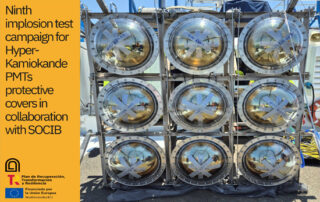
Ninth implosion test campaign for Hyper-Kamiokande PMTs protective covers in collaboration with SOCIB
Last week, the ninth implosion test campaign to validate the protective covers for the sensors of the future HK neutrino telescope was successfully completed. Over the course of a week, a team of seven members from the LSC and UdG carried out the tests at the SOCIB facilities in Palma de Mallorca. A total of three tests were performed, confirming that the initial production of protective covers are capable of containing an implosion in the event of a sensor failure. One step closer to making Hyper-Kamiokande even safer.
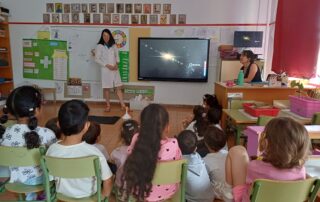
Workshop: ‘The Universe: Origin and Composition’ CEIP San Juan de la Peña
On Thursday 4 June, the workshop ‘The Universe: Origin [...]

Arrival of the Second GeRysy Detector for the JASC-LSC Project
On May 19, the second ultra-low-background HPGe spectrometer, based on a large SAGe-geometry crystal, was received as part of the Jagiellonian Advanced Screening at Canfranc (JASC) project. The spectrometer has been installed in the clean room of Hall C and cooled with liquid nitrogen, awaiting the next calibration steps and the shielding that will complete its installation. Researchers from the Jagiellonian University in Kraków travelled to the LSC to oversee the process. Following the established naming convention, the detector has been christened GeRysy II.
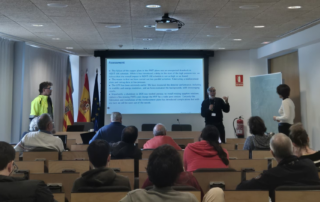
38th meeting of the LSC Scientific Advisory Committee
The 38th meeting of the Scientific Committee was held [...]
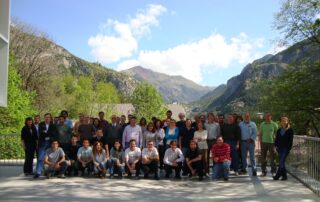
NEXT Collaboration Meeting
The 2026 NEXT collaboration meeting was held at the [...]

The LSC Holds Its 2nd Science Classroom for Secondary School Students
From May 12th to 14th, the LSC held the second edition of its Science Classroom for 2nd-year secondary school students, bringing together 40 students from five schools in Navarra and Valladolid. During these days, the students enjoyed a scientific programme specially designed for them, including physics, chemistry and biology workshops, as well as talks and experimental activities that allowed them to carry out their own field measurements and experience science in a practical and engaging way. We hope this experience has inspired you to continue discovering the world of science.